In honor of National Career Development Month, we’re celebrating the second annual Global Leaders Career Development Award and the schools connecting everyday instruction to real-world learning, global perspectives, and career-ready skills.
This year’s winners are Stanfield Elementary School (Stanly County Schools, NC), Grandview Middle School (Hickory City Schools, NC), and Ashe County Early College High School (Ashe County, NC). Alexander Wilson Elementary School (Alamance-Burlington Schools, NC) and Chowan Middle School (Edenton-Chowan Schools) are finalists. Each school is helping students see how what they learn, the strengths they build, and the challenges they care about can shape their future pathways.
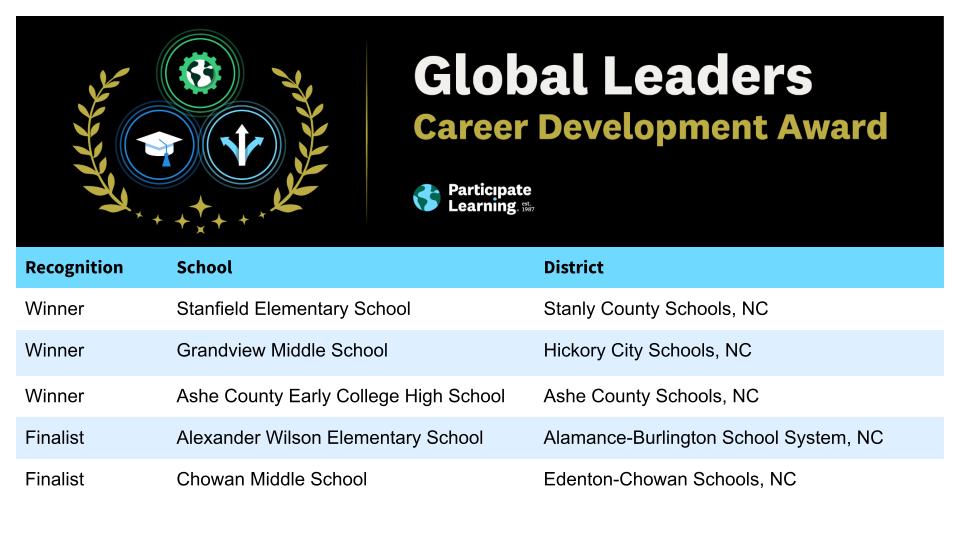
The award recognizes schools that use Participate Learning’s whole-school framework to connect everyday instruction with real-world learning, global perspectives, community partnerships, and career-ready skills. Each winning school receives a $500 grant to support future career development activities.
Across grade levels and academic subjects, the recognized schools make three connections visible for students: where academic content appears in professional work, which skills and competencies that work requires, and how careers–and students themselves, no matter their age–can help communities address real problems.
At Stanfield Elementary, curriculum-aligned career exploration makes learning relevant
At Stanfield Elementary School, career readiness begins with the soil beneath students’ feet.
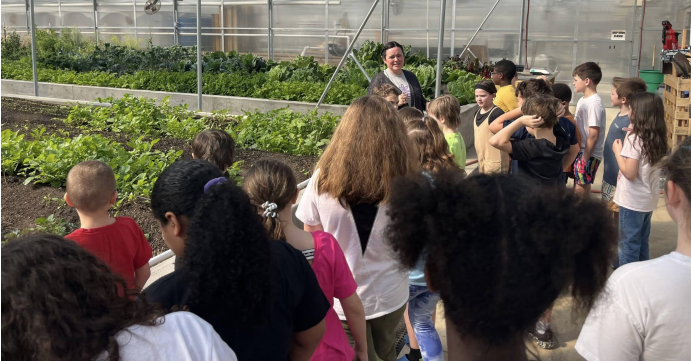
Students connect science instruction to the knowledge and work involved in agriculture through several grade-specific experiences. Third graders study soil health and sustainable food production before visiting Juneberry Ridge, a working regenerative farm in Norwood, North Carolina. During the visit, they explore soil, water, wildlife habitats, and aquaponics, a system that combines growing plants with raising aquatic animals. Students see how scientific concepts shape decisions about food production and natural resource use.
In a separate partnership, fifth graders work with Stanly Community College to connect their genetics unit to agricultural careers and educational pathways. They learn about farm operations, agricultural supplies, business, and environmental education. Students also compare agricultural practices around the world, examining how geography and available resources influence food production.
Stanfield kindergarteners bring another part of the agricultural system to life by hosting a farmers market, taking an active role in an experience that connects science, business, and community engagement.
Together, these experiences reflect the Global Leaders approach: begin with grade-level content, connect it with a real-world challenge, and use community partners to show students how that learning appears in professional work.
Stanfield Elementary Principal Lindsay Merritt says, “[Students] are learning that they do not have to wait until adulthood to be leaders, problem-solvers, and contributors to their communities. They can begin discovering their potential now.”
Try this: Ask teachers to choose an upcoming unit and identify one local industry that uses the same content. Invite a community partner to show students how that knowledge informs decisions at work.
At Grandview Middle, career research reveals a profession’s purpose
Grandview Middle School asks students to look beyond job titles and examine what a profession enables someone to contribute.
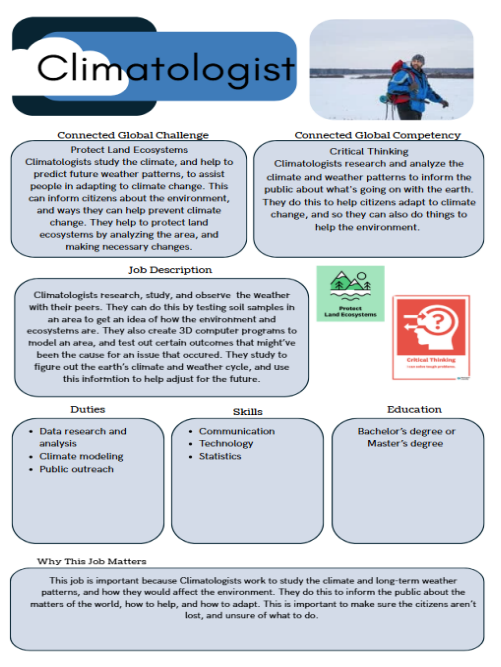
Eighth graders research a global challenge they care about, identify a career that could contribute to a solution, and create a recruitment poster explaining the profession’s responsibilities and potential impact. One student connected climatology with protecting land ecosystems, explaining how climate research helps people understand environmental changes and prepare for their effects.
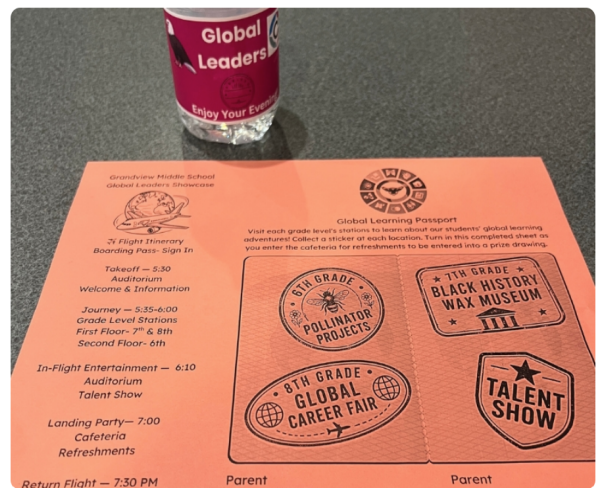
The project culminates in a mock career fair during Grandview’s Global Leaders Showcase. Students present their posters to families and other visitors, giving them a real audience for their research and ideas. Interest-based clubs, guest speakers, and career labs extend that exploration through activities such as drawing blood, changing an engine’s oil, and making sunscreen.
Global Leaders gives the work a common structure: a global challenge to investigate, a career connection to explore, and an audience that expects students to explain why the work matters.
Katrina Palozzi, Career Development Coordinator for Grandview, says, “By investigating challenges that sparked their interest, students developed a deeper understanding of themselves, their passions, and how they might use future careers to make a meaningful impact on the world.”
Try this: Ask students to begin career research with a problem: What does this profession help people understand, improve, protect, or create?
At Ashe County Early College, reflection helps students connect their strengths to future pathways
At Ashe County Early College High School, career exploration includes structured opportunities for students to consider what they care about and which strengths they could contribute.
Ninth- and tenth-grade students explore their aspirations through four interest-based groups called HUBs: Life Sciences, Creative Industries and Entrepreneurship, Applied Science and Innovation, and Justice, Advocacy, and Human Services.
Students use Action-Driven Learning, a Global Leaders approach that guides them through investigating a challenge and taking informed action. Digital portfolios help students identify strengths, set academic and career goals, and document evidence of communication, collaboration, critical thinking, and problem-solving.
Those reflections are grounded in experience. For three years, students have partnered with New River State Park to remove approximately two tons of Japanese stiltgrass annually. The invasive species smothers native wildflowers, chokes out tree seedlings, and alters soil and light conditions. The project connects environmental stewardship with careers in ecology, conservation, and natural resource management.
Global Leaders and Action-Driven Learning turn a challenge from a research topic into an opportunity to use academic knowledge, work with a community partner, and reflect on the competencies students practiced.
Principal Lindsey Williams says, “Our Global Leaders initiative is helping students see the connection between who they are, what they care about, and who they hope to become.”
Try this: After a project or community engagement experience, ask students to name one skill they used, cite evidence from their work, and identify another career in which that strength matters.
At Alexander Wilson and Chowan Middle, hands-on activities invite career exploration
The two finalist schools use hands-on experiences to help students test their interests before choosing a pathway.
Alexander Wilson Elementary School
At Alexander Wilson, fifth graders explore 10 professional fields through an interactive Career Kit built around a pet rock. Students collect customer feedback as designers, calculate costs and profits as accountants, and write and debug instructions as programmers. Other activities introduce students to environmental science, culinary arts, journalism, manufacturing, and medicine.
The reflection built into the Career Kit connects these activities with Global Leaders’ emphasis on career-ready competencies. Students do more than sample professional tasks: they also identify where they used communication, creativity, critical thinking, and problem-solving, then consider which kinds of work best fit their interests and strengths.
Try this. Build a short sequence around one shared object, question, or scenario. Let students approach it through several professional roles, then compare which work and competencies interested them most.
Chowan Middle School
At Chowan Middle School, quarterly STEM Days connect local industries with global challenges through the Global Leaders Blueprint for a Better World, a tool that organizes challenges students can study and act on.
Across the year, the STEM Days focus on maritime science, agriculture, renewable energy, and manufacturing. During Marine STEM Day, students build submarines, investigate buoyancy, construct bridges, explore hydroponics and water-powered energy, and use engineering software to modify designs before construction.
When a design does not work as expected, students test it, make changes, and try again. Career development portfolios help them consider whether they are most interested in designing, building, working with technology, investigating marine life, or solving environmental problems.
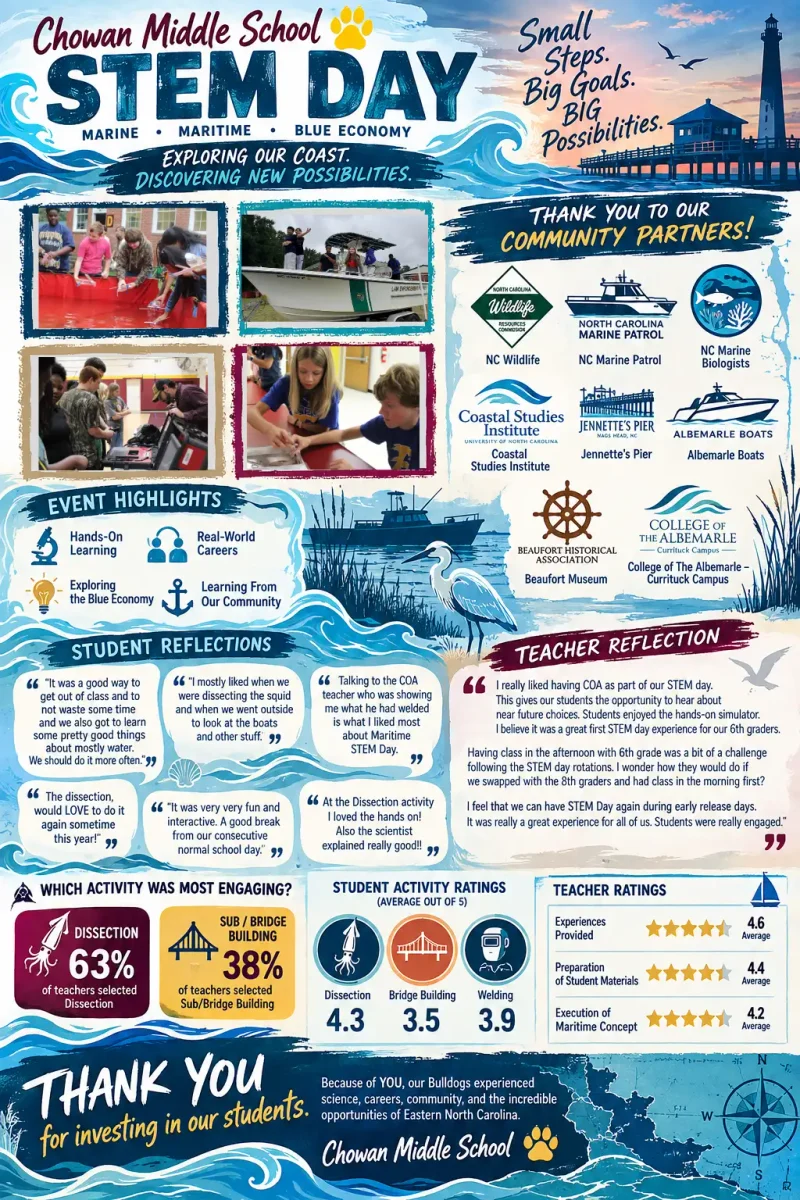
The Blueprint gives educators a shared way to connect community industries, academic content, career-ready competencies, and challenges that matter locally and globally.
Martha Foster, a Chowan Middle staff member, says, “The skills [students] practice in middle school—creating, questioning, collaborating, adapting, and solving problems—are the same skills professionals use to address real challenges in their communities and around the world.”
The Career Development Award also recognizes Efland-Cheeks Global Elementary School, Elon Elementary School, River Road Middle School, and Roosevelt Middle School with honorable mentions.
Start with the instruction and partnerships you already have
Across the recognized schools, educators consistently make three connections visible:
- How academic content appears in professional work
- How critical thinking, communication, collaboration, and other competencies support that work
- How careers respond to needs in local and global communities
You can begin with one upcoming unit or an existing community partnership. Identify a related career, choose a competency students can practice, and add a brief opportunity for students to reflect on what they learned about the work and themselves.
At Stanfield, the connection begins with soil. In another school, it might begin with a novel, a math problem, or a local employer. Making that connection explicit gives students more information about their futures and a clearer reason for the learning they are doing today.
Build career readiness into everyday instruction
The Global Leaders framework helps schools connect academic learning, global competencies, community partnerships, and future careers through a shared schoolwide approach.
Looking for ways to connect classroom learning with career readiness? Download A Practical Guide to Career Readiness in K–12 Schools for additional strategies.