Yves had taught for 15 years. Walking into a classroom—any classroom—he knew what to do. But when he decided to teach in the U.S., he encountered a different kind of unknown. The visa process. Securing housing. A school system he’d never worked in. “I’m afraid of the unknown,” he says. “It is very hard to bet on things that you do not know.”
He’s not alone in this fear.
If you’re nervous about teaching abroad—getting the visa, securing housing, starting at a new and unfamiliar school—you’re not alone. Every Ambassador Teacher (Participate Learning’s term for the international educators we sponsor to teach in U.S. classrooms) featured in this piece carried that same nervousness onto the plane. And every one of them found that the support they needed was already there.
In this article, you’ll hear from:
- Yves — The Philippines
- Regina — Kenya
- Daniel — Colombia
- Charlene — Trinidad and Tobago
- Cecilia — Argentina
- Kim — South Africa
- Diego — Argentina
Arrival: when nervousness turned into belonging
Regina had only ever traveled to places neighboring her home country, Kenya, before applying to teach in the U.S. Teaching abroad meant leaving Africa for the first time. She didn’t know what to expect on the other side.
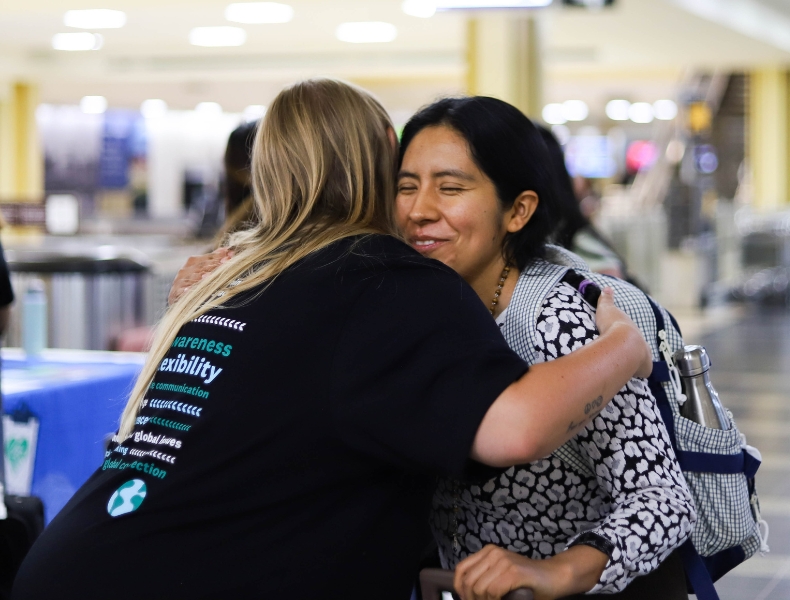
Daniel from Colombia had the same worry and experienced the same surprise. “I remember I landed in North Carolina,” he says, “and there were people ready to open their arms and hug me. It was immediately a soothing experience. I had reached a community of people on the same boat as me.”
Arrival support is just the beginning. The real test of a sponsor is whether they follow through all year long. Charlene was nervous about what would happen after the welcome wore off. She’d already heard mixed things from teachers in other programs.
Hear more from teachers about their arrival:
How nervousness about long-term support gave way to real reassurance
Before Charlene from Trinidad and Tobago joined Participate Learning, she’d heard from teachers who’d used another sponsor agency their first time in the U.S. They told her Participate Learning’s support was far better. She soon found out they were right.
“There are teachers who are in the Participate Learning program who have been in another program before, and shared that they didn’t get this level of support,” she says. “It helps me feel that I’m safe in this program, that I made a good decision.”
But arrival and year-round support alone aren’t what sealed the decision for some teachers. For those with families, the calculus was bigger.
Hear more from teachers about the support they felt:
Teaching abroad with family: a shared growth experience
For a teacher with a spouse or kids, the decision to teach abroad can carry extra weight: a new language for a partner or child to learn, unfamiliar cultural norms to adjust to, a new school, new jobs, new friendships to build from the ground up.
Cecilia, an Ambassador Teacher from Argentina, and her husband made the decision together. “We thought of it as a family project,” she says. “It was not just for me, but also for my family.”
Teaching abroad has also led to growth for Kim’s family, who moved from South Africa. Her three-year-old is thriving in preschool, and her husband has “grown in leaps and bounds within himself in a social and personal way.” “It’s incredible to see him grow,” she says.
Teaching in the U.S. became the biggest career leap they’ve made
Career growth is one of the biggest reasons teachers apply to become cultural exchange teachers in the first place. For some, it went even further than they expected.
Cecilia knew she would teach, but didn’t expect to also become a mentor and a conference speaker. “I’ve been able to deliver professional development sessions, international conferences, things I never thought I would be doing,” she says. “I’ve been a mentor for new teachers. I’m bringing so many things back to my country.”
Diego, from Argentina, sees the same effect, building new expertise to benefit his students here and in his home country. “The teaching experience in the U.S. will benefit my career in the future, because I will be able to get my master’s here,” he says. “Every meeting, I learn something new, and I apply that knowledge in the classroom.”
“I’m so proud of the person I’ve become,” Daniel says. “It has grown so many good values within me—empathy, tolerance toward the unknown, toward difference. There are more things I have in common with people from very different backgrounds than I ever thought.”
Hear more from teachers about why they wanted to teach in the U.S.:
Every worry turned into something worth having gone through
“It is okay to have fears and doubts because you don’t know what you don’t know, and that can be scary,” Daniel says. “But once you invite that opportunity into your life, life changes.”
Cecilia doesn’t describe the nerves as something she got past so much as something that kept paying off. “Every challenge is an opportunity to grow,” she says. “I’ll never regret this experience.”
For all of these teachers, the nervousness was real, and so was what came after. Yves put it simply: he managed to adjust, to adapt, to survive, and to thrive. Fifteen years into his teaching career, he found a version of himself he hadn’t expected to meet.
Participate Learning has sponsored international teachers through BridgeUSA, the State Department’s J-1 Exchange Visitor program, since 1987. The team that met Daniel at the airport and the follow-through that Charlene noticed are part of how every Ambassador Teacher’s entire experience is built, backed by a local adviser and a Teacher Resources team available whenever they’re needed.
If you’re weighing that same decision now, you can learn more about the Ambassador Teacher program at participatelearning.com/international-teachers/apply/.
A few honest FAQ answers, if you’re still deciding
Is it normal to feel nervous about teaching abroad?
Yes. Every Ambassador Teacher quoted in this piece describes some version of nervousness before they left home: about the unknown, about their family, about whether they’d be ready. None of them describes it as a sign they’d made the wrong decision.
What should a J-1 sponsor’s support actually include?
When you choose a J-1 sponsor, you should expect a team ready at your arrival, a local adviser who helps you settle in, check-ins throughout the year, and instructional support that goes beyond day one, because your first year is where the most support matters.
How is Participate Learning’s support different from other J-1 sponsors?
Ambassador Teachers, like Charlene, describe a level of ongoing support they didn’t expect based on what they’d heard elsewhere. Not just help getting the visa, but support that continues for the length of their placement.