As today’s graduates begin their careers, they’ll tackle challenges in their communities that mirror issues worldwide—like making thoughtful decisions about how communities manage shared resources or strengthening local health systems. They will work with colleagues from diverse cultural, linguistic, and professional backgrounds, often across time zones and countries. Success in this environment hinges on global competence.
Developing that competence requires more than academic knowledge alone. Through sustained engagement with real-world problems, guided collaboration, and practice in communication and critical thinking, students build the skills employers consistently identify as essential. Let’s explore what it means to be globally competent and how educators can ensure students are prepared for career success.
The Main Idea: What Is Global Competence?
Global competence is the ability to understand local and global issues, consider different perspectives, and take informed action. In K–12 education, global competence helps students connect classroom learning to real-world challenges and build essential career readiness skills.
Globally competent students can:
- Collaborate with people from different backgrounds
- Think critically about complex problems
- Communicate clearly in speaking and writing
- Apply academic learning to real-world situations
These skills, often called 21st-century skills, prepare students for college, careers, and active participation in their communities.
Want to empower your students with future-ready skills? Download our free ebook, From Classroom to Career: The Global Leaders Advantage to build on your school’s commitment to preparing students for success.
What Does It Mean to Be Globally Competent?
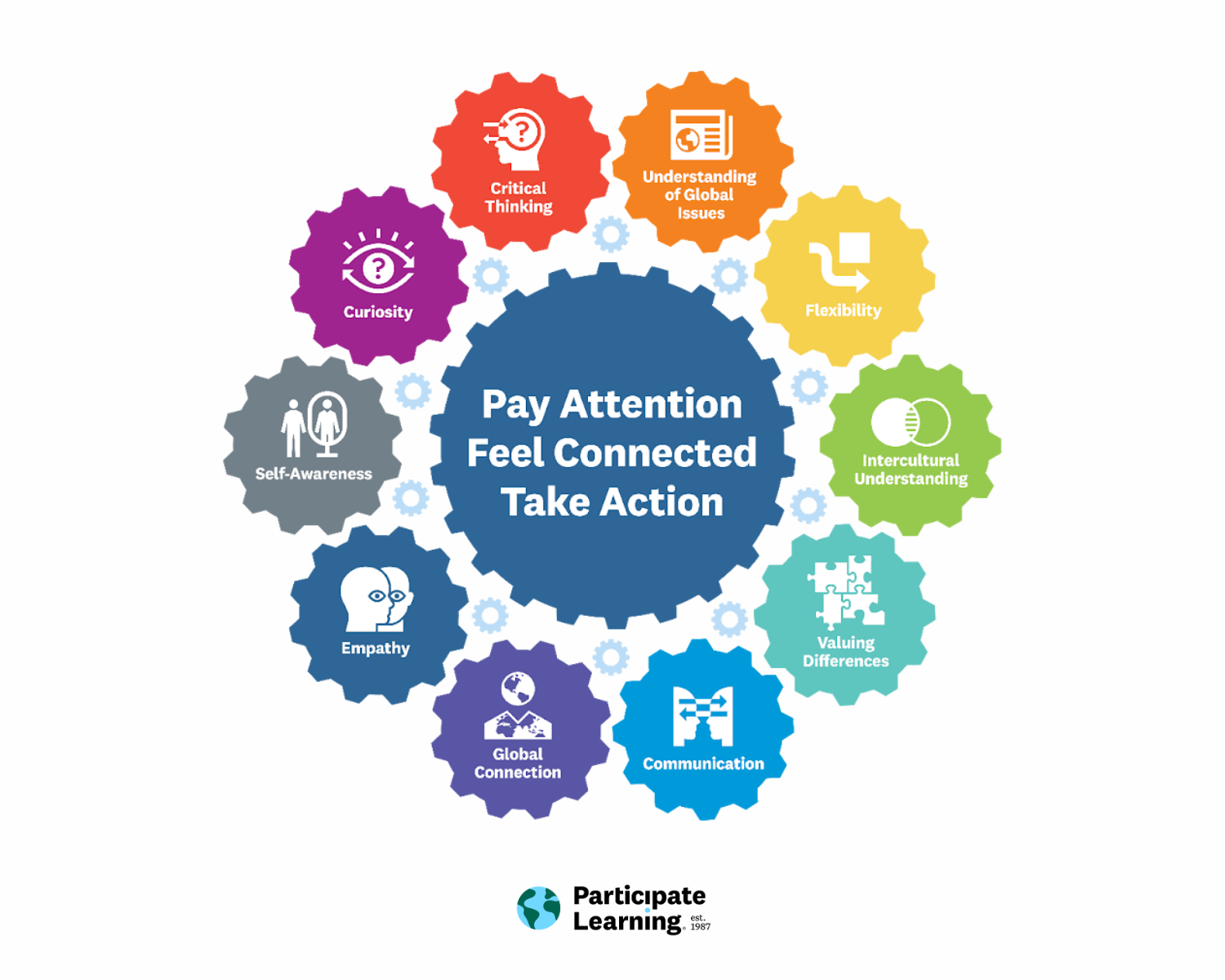
Global competence describes a set of interconnected skills that prepare students for modern careers. Rather than focusing on memorizing facts about other cultures, globally competent students learn how to work effectively with different people, solve real problems, and adapt to changing situations—exactly what employers need in today’s workforce.
A globally competent student can:
- Work Effectively in Teams: They collaborate with people from different backgrounds to achieve shared goals, bringing their own perspective while remaining open to others’.
- Engage with Real-World Challenges: They tackle issues like sustainability, technology access, and global health by analyzing root causes and developing actionable solutions.
- Think Critically and Take Action: They evaluate information from multiple sources, make decisions based on evidence, and follow through with solutions that create real change.
- Apply Learning Beyond the Classroom: They connect what they’re learning in math, science, and social studies to challenges they see in their neighborhoods and beyond.
- Communicate with Clarity and Purpose: They express ideas clearly and listen carefully to others. This makes collaboration easier and problem-solving more effective.
These abilities make students stronger learners—and eventually stronger professionals who are ready for the modern workforce.
The Link Between Global Competence and Career Readiness
Employers today look for more than technical knowledge. Developing global competencies helps students gain these essential workplace skills.
Employer surveys consistently mention that organizations are looking for people who can:
- Collaborate with different teams
- Adapt to change and apply creative problem-solving
- Deliver clear written and verbal communication
- Recognize multiple viewpoints and use them to strengthen ideas and solutions
- Take initiative and think strategically when facing challenges
When schools intentionally teach global competence, they help students build these essential workplace skills early.
How Schools Can Develop Globally Competent Students
If you’re an educator or administrator reading this, you already know your students will enter a job market that looks nothing like the one you entered. In a workforce defined by rapid change and global connection, the question isn’t if global competence matters, but how to build it into daily teaching and learning.
1. Connect Learning to Real-World Challenges
Design lessons that connect grade-level standards to real challenges. Topics such as resource use, new technologies, and community health can fit naturally into science, social studies, literacy, and math instruction. When students engage with real issues—not hypothetical scenarios—they develop problem-solving, adaptability, and teamwork skills that carry directly into their careers.
At Stough Magnet Elementary School (Wake County Public Schools, NC), third graders noticed their community lacked access to clean water. Instead of just learning about water cycles in science class, they researched the specific barriers their neighbors faced, developed solutions, and implemented changes that made a real difference. The project went beyond the science standards. It showed them what their learning could accomplish in the world.
This is what meaningful, real-world learning looks like: students applying academic content to authentic problems.
2. Strengthen Teamwork Through Local and Global Connections
Encourage students to collaborate with classmates, community leaders, and peers from other parts of the world. Virtual discussions, collaborative projects, and mentorship opportunities help students understand different approaches to solving problems and improve their ability to work well in a team.
West Oxford Elementary students partnered with Nestlé to explore food insecurity and its local and global impacts. They created a school garden to support local families. Through the project, students practiced teamwork, planning, and problem-solving, all key career readiness skills.
3. Foster Critical Thinking and Perspective-Taking
Create structured opportunities for students to explore different viewpoints. Use classroom discussions, case studies, and project-based learning activities. These experiences strengthen critical thinking, communication, and leadership skills—all essential in professional settings.
Many schools that integrate global competence use an “In Your Shoes” activity where students analyze real-world scenarios from multiple perspectives. A manufacturing decision that creates jobs in one community might harm the environment in another. A technology innovation that improves efficiency might displace workers. Students learn that most meaningful decisions involve tradeoffs, and understanding those tradeoffs requires seeing the full picture.
This kind of perspective-taking shows up in every workplace. The engineer who understands how her design affects the supply chain team. The teacher who considers how a policy change impacts families with different schedules. The manager who recognizes that what motivates one team member might discourage another. These are career-readiness skills built on a foundation of genuine perspective-taking.
4. Promote Problem-Solving Through Action-Driven Learning
Guide students through clear problem-solving steps: identify a challenge, research it, propose solutions, gather feedback, and improve the plan.
Students at Heritage Middle School (Burke County Public Schools, NC) noticed the amount of plastic waste their school generated every day. Rather than accepting it as “how things are,” they researched the impact, proposed solutions, and launched a school-wide recycling initiative. Through research, teamwork, and strategic planning, they implemented a program that’s still running today.
The recycling program was the outcome. The learning happened in everything that led to it: identifying a problem worth solving, researching what actually works, building support from adults and peers, and following through when the initial excitement wore off. These are the skills that turn good ideas into real outcomes.
Key Takeaways
Building global competence in K–12 education strengthens career readiness. When students practice teamwork, adaptability, critical thinking, and communication, they develop the skills they will need in any career.
By connecting standards-based instruction to real-world challenges, schools prepare students for life beyond the classroom.
Looking to Strengthen Career Readiness in Your School?
Global competence provides a clear path to building 21st-century skills in K–12 classrooms. Download our free ebook, From Classroom to Career: The Global Leaders Advantage, to explore practical strategies for integrating global competence into your school’s approach to teaching and learning.