Dual language instruction is an approach to K–12 education in which students learn core academic content—mathematics, science, social studies, language arts—and literacy in two languages, typically English and a partner language.
The languages are not treated as interchangeable supports. Each has an intentional role in a program designed to develop bilingualism and biliteracy, academic achievement, and sociocultural competence.
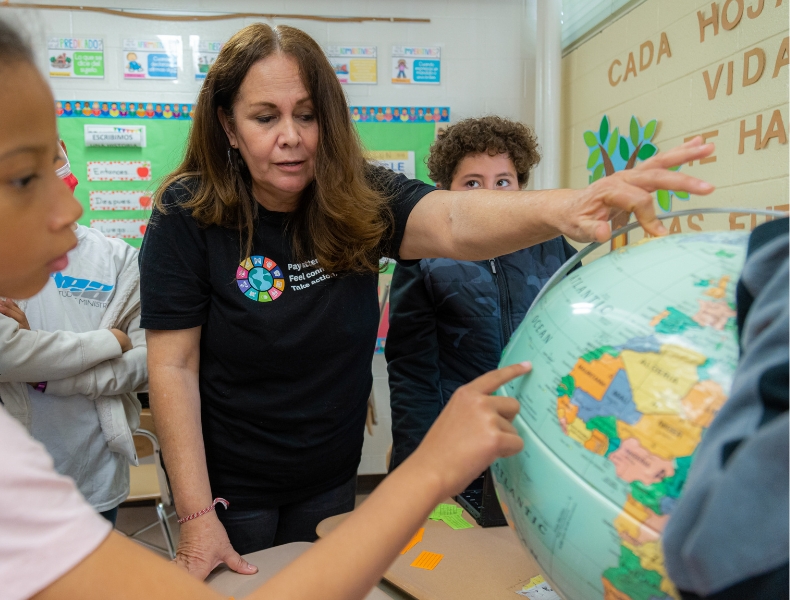
When Latreicia Allen served as principal of William H. Owen Elementary School in Cumberland County Schools, North Carolina, she saw those goals take shape in ways that extended beyond test scores and language proficiency.
“We’ve seen empathy,” she reflected. “We’ve seen that the students are really putting themselves in other cultures’ shoes and other classmates’ shoes, to really empathize with their learning experiences and their overall culture experiences.”
Her observation captures the promise of a well-designed program: students develop two languages, meet high academic expectations, and learn to communicate across cultures. Reaching all three outcomes requires coherent program design, qualified educators, strong instruction, family partnership, and sustained leadership.
Dual language instruction at a glance
- Students learn grade-level academic content and literacy through English and a partner language.
- Schools may allocate instructional time using approaches such as 90/10 or 50/50.
- The three central goals are bilingualism and biliteracy, academic achievement, and sociocultural competence.
- Strong programs are designed as long-term pathways rather than short-term language interventions.
In this guide
- What dual language instruction means
- How dual language differs from bilingual, ELL, and world language programs
- The three goals of high-quality dual language education
- One-way vs. two-way programs and 90/10 vs. 50/50 language allocation
- How schools choose a program model
- The benefits of dual language education
- What sustainable implementation requires
- How districts can begin planning
- Frequently asked questions
What is dual language instruction?
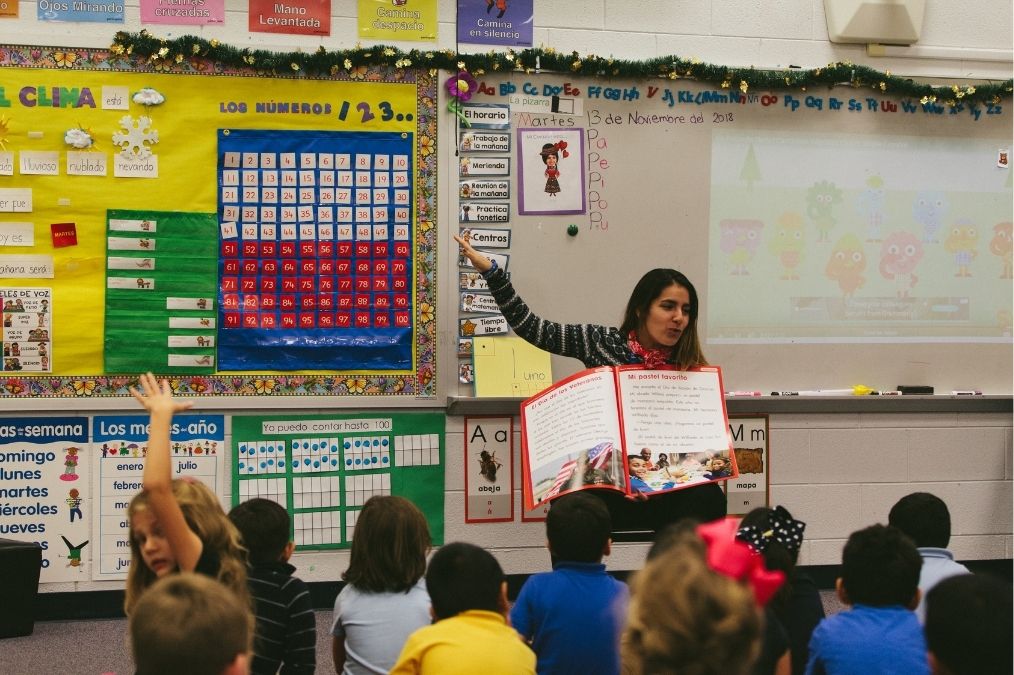
Dual language education delivers grade-level content and literacy instruction to all students through two languages, usually English and a partner language. Programs typically begin in kindergarten or first grade and continue for multiple years because language, literacy, and academic growth develop over time.
A dual language classroom, therefore, looks different from a traditional world language class. Rather than studying the partner language as a subject, students use it to make sense of academic concepts, discuss ideas, read complex texts, solve problems, and demonstrate what they know.
A strong program also develops literacy in both languages. Speaking and listening matter, but so do reading, writing, and the academic language students need to participate fully across subject areas. The objective is additive bilingualism: students build a new language while continuing to develop the language they already bring to school.
How is dual language instruction different from bilingual, ELL, and world language programs?
The terms are often used interchangeably, but they do not describe the same educational design. Understanding the distinction helps school leaders set accurate expectations with families, staff, and their wider community.

Bilingual education
Bilingual education is an umbrella term for programs that use two languages in instruction. Programs under that umbrella may have different goals. Some are designed to maintain and develop two languages, while others use a student’s home language temporarily as the student transitions toward English-only instruction.
Dual language education is a long-term bilingual model with the explicit goal of developing proficiency and literacy in both languages.
English language learners
English learner services help multilingual learners gain access to academic content while developing English. Those services may be delivered in English or may incorporate students’ home languages.
Dual language programs can serve English learners, but they are not simply an English-acquisition intervention: all participating students work toward bilingualism and biliteracy.
World language classes
In a conventional world language course, the language itself is the subject, and instruction often occupies one class period. In dual language instruction, students use the partner language to learn grade-level content for a substantial portion of the school day.
Language immersion
Language immersion describes instruction delivered through a language that students are acquiring. Dual language immersion adds a sustained commitment to academic content, literacy development in two languages, and the three program goals described below.
Terminology varies across states and districts, so schools should define their model clearly whenever they communicate with families.
The three goals of high-quality dual language education
Dual language programs are organized around three connected goals. These goals provide both a promise to families and a framework for evaluating program quality.
- Bilingualism and biliteracy. Students develop the ability to listen, speak, read, and write in English and the partner language. A program should define what progress looks like in each language, assess it intentionally, and protect time for both languages across grade levels.
- High academic achievement. Students are expected to meet grade-level academic standards while learning through two languages. The partner language must carry real intellectual weight: rigorous content, high-quality texts, purposeful discussion, and meaningful assessment rather than simplified or translated-after-the-fact materials.
- Sociocultural competence. Students learn to understand their own identities, engage respectfully with others, and communicate across cultural and linguistic contexts. This goal should be visible in curriculum, classroom relationships, family engagement, and whose knowledge and language are treated as assets.
The goals reinforce one another. Language development without academic rigor falls short. Strong grades without biliteracy miss the model’s defining promise. And a program that teaches two languages while treating one culture as supplementary cannot fully develop sociocultural competence.
One-way vs. two-way dual language programs
The most important distinction is simple: one-way and two-way describe the language backgrounds of participating students; 90/10 and 50/50 describe how instructional time is allocated between languages. They are related design choices, but they are not synonyms.
| Factor | One-Way Program | Two-Way Program |
|---|---|---|
| Student Population | Students primarily come from one language group. | Students come from two substantial language groups, commonly English speakers and speakers of the partner language. |
| Peer Language Resources | Students rely more heavily on educators, curriculum, and planned interaction for partner-language models. | Students can learn with peers who bring different strengths to each program language. |
| Common Fit | Communities with one predominant student language group or a world-language immersion pathway. | Communities able to recruit and sustain participation from both language groups. |
This distinction is supported by federal education resources, including the National Clearinghouse for English Language Acquisition, which treats student population and language-allocation policy as separate parts of program design.
What do 90/10 and 50/50 mean?
Language-allocation models describe how much instructional time students receive in each language. They do not, by themselves, determine whether a program is one-way or two-way.
In the 90/10 model, students receive approximately 90 percent of early-grade instruction in the partner language and 10 percent in English. The English share typically increases over time until instruction reaches a more balanced allocation in later grades.
In the 50/50 model, students receive approximately half of their instruction in English and half in the partner language across grade levels. Schools may divide time by subject, teacher, part of the day, or another consistent plan.
A school can operate a one-way 50/50 program, a two-way 90/10 program, or another clearly defined model. What matters is that the design is grounded in research-based dual language principles, reflects the linguistic needs of the student population, protects sustained instruction in both languages, and can be implemented consistently with the appropriate staffing, curriculum, and resources.
Which dual language model fits your school?
There is no universally best model because the strongest choice is the one a district can implement successfully and sustain across grade levels. Before selecting a design, leadership teams should answer five questions.
- Who are the students the program is intended to serve? Review home-language data, enrollment patterns, feeder schools, community demographics, and access barriers. In a two-way design, consider whether the district can recruit and retain substantial groups of students from both language backgrounds.
- What outcomes will define success? Set goals for proficiency and literacy in both languages, academic achievement, sociocultural competence, access, persistence, and family experience. Define how progress will be measured before the program launches.
- Which educators are available? Map certification, language proficiency, content expertise, and knowledge of second-language acquisition. Decide whether a one-teacher or partner-teacher structure is realistic at each grade level.
- Is high-quality curriculum available in both languages? Avoid building the partner-language curriculum through direct translation alone. Materials should be standards-aligned, linguistically appropriate, culturally relevant, and usable by teachers across the planned pathway.
- Can the district sustain the pathway? Plan beyond the first kindergarten cohort. Staffing, budget, curriculum, assessment, family communication, and course progression must continue as students advance.
Schools ready for a deeper planning process can explore our dual language implementation guide and student recruitment guide.
What are the benefits of dual language instruction?
The clearest benefit is also the model’s central purpose: students have the opportunity to develop academic proficiency and literacy in two languages. When programs are implemented well and sustained over time, that foundation can support academic learning, communication, cultural understanding, and future education and career pathways.
Academic and linguistic development
Research summarized by the Center for Applied Linguistics associates participation in dual language education with positive academic and linguistic outcomes for English learners. Results depend on program quality, duration, access, and local implementation, so schools should evaluate their own outcomes rather than treating the model name as a guarantee.
Communication and biliteracy
Students learn to communicate ideas, interpret texts, and demonstrate knowledge across languages. Biliteracy can expand access to advanced coursework, community participation, the Seal of Biliteracy, and multilingual college and career opportunities.
Sociocultural competence
Learning alongside people with different linguistic and cultural experiences gives students repeated opportunities to listen, adjust, collaborate, and see a problem from more than one perspective. Those experiences are most powerful when a program intentionally values both languages and communities.
For a fuller discussion, read What Are the Benefits of Dual Language Programs? and What Are the Benefits of a Bilingual Brain?.
What high-quality dual language instruction requires
A program model creates the structure. Consistent implementation determines whether the program delivers on its promise. Research-based guidance emphasizes several connected conditions.
- A clear, protected program design. Document the student population, language-allocation plan, instructional responsibilities, entry and continuation policies, and pathway across grade levels. Protect the plan from gradual drift while using evidence to make deliberate improvements.
- Qualified educators and strong instructional leadership. Dual language educators need the language proficiency and content knowledge required for their assignments, along with expertise in language development, biliteracy, scaffolding, assessment, and culturally responsive instruction. Administrators also need enough model-specific knowledge to observe instruction, allocate resources, and give useful feedback.
- Rigorous curriculum in both languages. Both languages should carry meaningful, grade-level learning. High-quality programs use authentic texts and standards-aligned materials that reflect the linguistic and cultural contexts in which they were created. Teachers need time and systems to plan across languages without relying on constant translation.
- Assessment that separates language from content. A student may understand a concept before having all the language needed to explain it in a particular language. Schools, therefore, need multiple measures that help educators distinguish content knowledge, language development, and literacy growth. Results should guide instruction and program improvement rather than serve only as an end-of-year judgment.
- Family and community partnership. Families should receive clear information in the languages they use, understand what progress may look like over time, and have meaningful opportunities to shape the program. Recruitment, enrollment, communication, and leadership structures should support access for both language communities.
- Sustained professional development. One workshop cannot carry a multiyear program. Teachers need ongoing learning, coaching, collaboration, and feedback connected to the model. Administrators need support with program design, observation, data use, staffing, family communication, and long-term planning.
Educators can explore our dual language instructional best practices and five proven instructional strategies for classroom-level guidance.
How do schools start a dual language program?
Launching a sustainable program is a multiyear process. Districts can begin with the following sequence.
- Build a cross-functional leadership team. Include district and school leaders, educators, multilingual learner specialists, families, and community members who represent the languages the program will serve.
- Study student and community needs. Analyze enrollment, home-language data, family interest, staffing, curriculum, facilities, transportation, and feeder patterns. Use that evidence to define the population and purpose of the program.
- Select and document the model. Choose the student-composition and language-allocation designs separately. Map the pathway by grade, subject, language, teacher, curriculum, and assessment.
- Prepare people and materials before launch. Recruit qualified educators, secure curriculum in both languages, develop family communications, train front-office staff, and establish professional learning for teachers and administrators.
- Monitor implementation and improve continuously. Track enrollment and access, language allocation, student proficiency, academic outcomes, family experience, staffing stability, and instructional quality. Use the findings to improve the program without abandoning its core goals.
FAQs about dual language instruction
What is the main goal of dual language instruction?
The goal is to develop bilingualism and biliteracy, high academic achievement, and sociocultural competence through sustained grade-level instruction in English and a partner language.
Is dual language instruction the same as bilingual education?
Dual language instruction is a type of bilingual education, but not every bilingual program is dual language. Some bilingual programs transition students toward English-only instruction. Dual language programs intentionally develop and maintain two languages over time.
What is the difference between one-way and two-way immersion?
One-way programs primarily serve students from one language group. Two-way programs bring together substantial groups of students from two language backgrounds, commonly English speakers and speakers of the partner language.
Is one-way immersion always 90/10?
No. One-way and two-way describe student composition, while 90/10 and 50/50 describe language allocation. A one-way or two-way program may use either allocation approach when it fits the program’s goals and context.
Which dual language model is best?
There is no single best model for every school. The right design depends on the students served, the outcomes the district prioritizes, available educators, curriculum, family interest, and the district’s ability to sustain the pathway across grades.
How long does a dual language program take?
Dual language education is designed as a long-term pathway, often beginning in kindergarten or first grade and continuing for at least five to six years. Districts should plan for continuity into later grades whenever possible.
Can students with different learning needs participate?
Dual language programs should be designed for access. Students may need differentiated instruction, special education services, or other supports, but a disability, language background, or current academic performance should not automatically exclude them from the opportunity to become bilingual and biliterate.
What professional development do dual language educators need?
Teachers need ongoing support in second-language acquisition, biliteracy, grade-level content instruction, scaffolding, assessment, sociocultural practice, and collaboration across languages. Administrators need model-specific support for observation, staffing, data use, family partnership, and program improvement.
Build a Dual Language Program That Lasts
Choosing a model is an important decision, but it is only the beginning. Sustainable dual language programs align design, instruction, leadership, assessment, professional learning, and family partnership around the same three goals.
That alignment is what turns bilingual instruction into the experience Latreicia Allen described: students growing academically while learning to understand their classmates, their communities, and the wider world with greater empathy.
Participate Learning’s Dual Language Mastery Program provides professional development, coaching, and practical tools for administrators and teachers who are starting a new program or strengthening an existing one.
Get support for your dual language program.
Connect with Participate Learning About the Dual Language Mastery Program
If the professional development gap is what you’re trying to address, this is a great place to start.
The Mastery Program is professional development for administrators and teachers who:
- Are starting a new dual language program
- Need support to improve an existing program