There’s a moment in every classroom when a student pauses, looks at a classmate, and realizes something they hadn’t noticed before. Maybe it’s during a conversation about family traditions, or while comparing holiday celebrations from different parts of the world. In that pause, something shifts. Curiosity replaces assumption. A question forms instead of a judgment.
These small moments matter more than we might think. According to the Future of Jobs Report 2025, which analyzes employers’ perspectives on the skills today’s students will need to be competitive in the future workforce, employers are increasingly seeking human-centered soft skills such as critical thinking, communication, and flexibility. At Participate Learning, we call these abilities global competencies—the career skills that help students connect, contribute, and lead in any setting.
Intercultural understanding, one of ten essential global competencies, is about recognizing how culture shapes everything: how people live, think, and communicate, whether they live in the next neighborhood or halfway around the world.
By teaching intercultural understanding in K-12 classrooms, schools can help students develop a career-ready skill that will serve them throughout their lives. They learn to listen deeply, question their own assumptions, and build trust with people whose experiences differ from their own. These are the skills that help someone walk into a new workplace, a new community, or a new challenge and find their way forward.
Why Intercultural Understanding Matters for Students
Culture is everywhere, even when we don’t notice it. It’s in the way a family celebrates a birthday, the way a friend greets their grandmother, or the way someone solves a problem. Culture is more than traditions we observe from a distance. It’s the lens through which we understand the world.
When students begin exploring intercultural understanding, they start to see these patterns. They notice how their own upbringing shapes what feels normal to them. They realize that other students in their classroom might have entirely different ways of showing respect, expressing disagreement, or celebrating good news. And they begin to understand that differences and similarities exist everywhere—not just across countries, but across streets, schools, and families.
This awareness changes how students show up in the world and how they develop their own sense of identity. They become better listeners. They ask more thoughtful questions. They pause before making assumptions. They start to see complexity where they once saw simplicity, and connection where they once saw difference.
In the classroom, this shows up in small but significant ways:
- A student asks a new classmate about their weekend tradition instead of assuming everyone’s Saturday looks the same.
- Another student notices a peer’s hesitation during a group project and adjusts their communication style.
- A third student realizes that what felt like rudeness was actually a different way of showing interest.
These are the human intelligence skills that employers need. They’re also the skills that help students build meaningful relationships, navigate conflict, and work effectively with people who see the world differently.
When intercultural understanding is intentionally taught, students learn to:
- Recognize how culture influences communication styles, problem-solving approaches, and decision-making
- Collaborate effectively with peers from different backgrounds by listening, observing, and asking respectful questions
- Approach unfamiliar situations with curiosity instead of judgment
- Build trust and rapport across cultural contexts, skills essential for leadership and teamwork
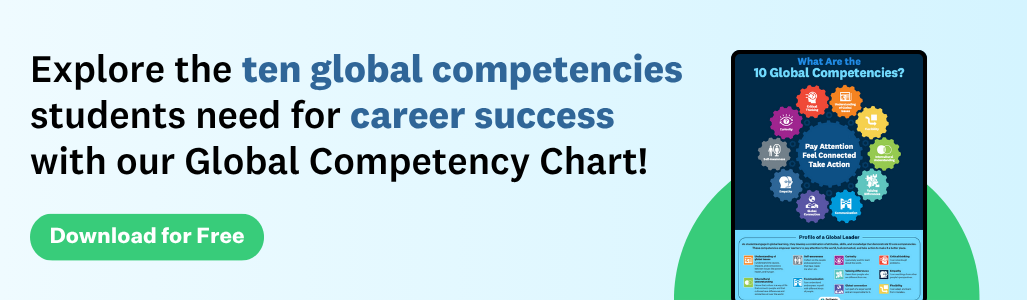
Explore all ten global competencies with our printable Global Competency Chart.
What Teaching Intercultural Understanding in K-12 Looks Like
Teaching intercultural understanding doesn’t require a special curriculum or extra time. It lives in the everyday moments of classroom life. Here are four strategies to create space for this learning:
1. Exploring Cultural Celebrations to Understand Shared Values
Invite students to explore how a community celebrates a meaningful holiday. For example, students might learn about Mother’s Day in the U.S. and Costa Rica.
Begin with a guiding question:
“What does this holiday say about what’s important to the people who celebrate it?”
As students learn about Costa Rican traditions, such as attending church, giving gifts, and spending the day with extended family, encourage them to reflect on what these practices suggest about values, including family connection, gratitude, and respect.
Next, invite students to reflect on a celebration from their own communities and consider what values it expresses. Rather than directly comparing cultures, guide students to notice shared themes and varied expressions of similar values.
You can conclude with a whole-class discussion or a visual organizer that captures students’ insights about values and traditions.
Career connection: This kind of values-focused reflection sharpens students’ analytical thinking and cultural awareness. It builds the skills needed to interpret unspoken norms, understand others’ priorities, and build trust—essential competencies for collaborating with clients, colleagues, and teams across cultures.
2. Using Cultural Lenses to Build Perspective-Taking Skills
To build a strong understanding of what culture is, have students explore how their own backgrounds influence how they see the world. Introduce the concept of a “cultural lens,” the way our own experiences shape what we notice, what we assume, and what we value.
Ask a scenario-based question like:
“You visit a friend’s house and notice they take off their shoes at the door. Why might that be important to them?”
Guide students to reflect on how their own upbringing shapes their reactions—a metacognitive practice that helps them recognize how cultural experience shapes thinking itself. Then, ask them to consider how someone else’s lens might offer a different interpretation, or to think about a time when they realized someone else’s lens was different from their own.
Career connection: This kind of reflection builds skills that matter deeply in workplaces and communities: the ability to pause, consider another perspective, and adjust how you communicate or respond. It’s how disagreements become conversations, and how teams learn to work across differences.
3. Creating Culture Quilts to Reflect on Identity
Invite students to design a square for a class culture quilt. The squares represent a story, tradition, or value from students’ families or heritage. Each square should include a drawing or symbol, along with one to two sentences explaining its meaning.
Once complete, have students present their squares to a partner or small group. Then, connect them into a collective display. The completed quilt becomes a visual reminder that every person in the room carries a history, a set of values, and a way of seeing the world.
To extend the activity, encourage students to reflect on what they learned about others and how that influences their understanding of the world.
Career connection: By sharing their stories and actively listening to others, students build confidence, empathy, and cross-cultural communication skills. This is the foundation for effective communication in interviews, presentations, and collaborative work.
4. Exploring Global Traditions Through Stories
To help younger students connect cultural practices to meaning, use a culture-rich example, such as the Ethiopian coffee ceremony—a ritual that involves roasting beans, brewing coffee, and sharing it with guests over conversation. After introducing the ceremony through a story or video, ask students:
“What does this tradition tell us about Ethiopian culture?”
“What is a food, piece of clothing, or tradition that is important in your home?”
Have students reflect by creating a collage using magazine clippings or drawing their own pictures to represent important items or traditions from their lives.
Career connection: This kind of learning helps students see that culture isn’t something distant. It’s present in the everyday rhythms of life. And when they learn to approach unfamiliar practices with curiosity rather than judgment, they’re building a mindset that will serve them in every field they enter.
How Pactolus Elementary Used Intercultural Understanding to Strengthen Community
Pactolus Elementary in North Carolina moves intercultural understanding beyond the classroom and into the heart of the school community during its annual Global Festival. It’s a day when the school becomes a place where culture is celebrated, explored, and lived.
Students move through interactive stations—learning dance steps, participating in a “walk in someone else’s shoes” empathy challenge, and exploring wildlife exhibits. Families share food, stories, and music from their own backgrounds. Local organizations join in, connecting the school to the wider community.
But the activities aren’t the only thing that make the festival meaningful. It’s the way students prepare, present, and reflect, too. In the weeks leading up to the event, they research cultures, create presentations, and explain their findings. They think about what questions to ask and practice how to listen.
On the day itself, students see their own heritage honored alongside traditions from around the world. They realize they belong to both a local community and a global one. They practice kindness, curiosity, and respect—not as abstract values, but as real actions that shape how they treat each other.
This is what intercultural understanding looks like when it moves beyond the classroom and into the life of a school. It’s students recognizing that culture shapes identity, that empathy builds bridges, and that all of us have a role to play in creating spaces where everyone belongs.
The Long-Term Impact of Intercultural Understanding
Intercultural understanding grows through repeated practice, reflection, and real encounters with people whose experiences differ from our own.
Over time, and long after they’ve graduated school, students who build this competency:
- Learn how to engage respectfully and collaborate with all kinds of people
- Become more skilled at interpreting unspoken cues and adapting their communication
- Approach new experiences with curiosity and a willingness to learn
- Build trust more easily because they’ve practiced seeing beyond surface differences
These abilities show up in their classrooms today—in the way they collaborate on projects, resolve conflicts, and include peers who might feel left out. And they’ll show up tomorrow in their workplaces, where they’ll need to lead teams, communicate, and build relationships across cultures and differences.
How a Global Learning Framework Helps Build Schools Where Intercultural Understanding Lives
Many schools recognize the importance of intercultural understanding, but making it a consistent, intentional part of everyday learning can be a challenge. Without a shared language or clear framework, this work often shows up in isolated lessons or special events, rather than quietly shaping how students learn and interact over time.
A global learning infrastructure helps bridge that gap. By embedding intercultural understanding and other global competencies into daily instruction, frameworks such as Participate Learning’s Global Leaders support schools in moving from good intentions to sustained practice.
By connecting learning to real, relevant experiences, schools prepare students for their futures while also shaping their present. It helps students feel seen. It teaches them to see others. It shows them that the world is wider and more connected than they might have imagined, and that they have something meaningful to contribute.
To learn more about global competencies, explore the full series or download our free, printable chart.
Want to learn more about global learning and career readiness? Download the Global Leaders overview here.