Many schools host food drives. Boxes appear in hallways, families donate what they’re able to, and students feel good knowing they helped. Those moments matter.
But at two Global Leaders schools, educators paused to ask a deeper question: What if a food drive wasn’t only about collecting canned goods, but also about helping students truly understand hunger, empathy, and their role in the community?
Instead of jumping straight to action, these schools intentionally moved students through a progression that builds both compassion and critical skills: Pay Attention. Feel Connected. Take Action. The result was not only more meaningful learning, but deeper student engagement.
Why Paying Attention Comes First in Action-Driven Learning
In many service projects, students are asked to do before they’re asked to understand. Global Leaders schools take a different approach with action-driven learning. Rather than rushing into action, they slow down the process and start by helping students pay attention.
By first paying attention—learning about an issue, listening to stories, and noticing how it shows up locally and globally—students build context. When they feel connected to the people affected, action becomes purposeful rather than something to check off a list. This process mirrors real-world skills students need beyond school, including empathy, problem-solving, communication, and collaboration.
EM Yoder Elementary and Central Elementary, two schools in our Global Leaders network, show what’s possible when schools take the time to do all three.
EM Yoder Elementary: Building Understanding Before the Food Drive Begins
At EM Yoder Elementary (Alamance-Burlington School System, N.C.), the annual food drive has evolved into something far more intentional—and therefore more impactful.
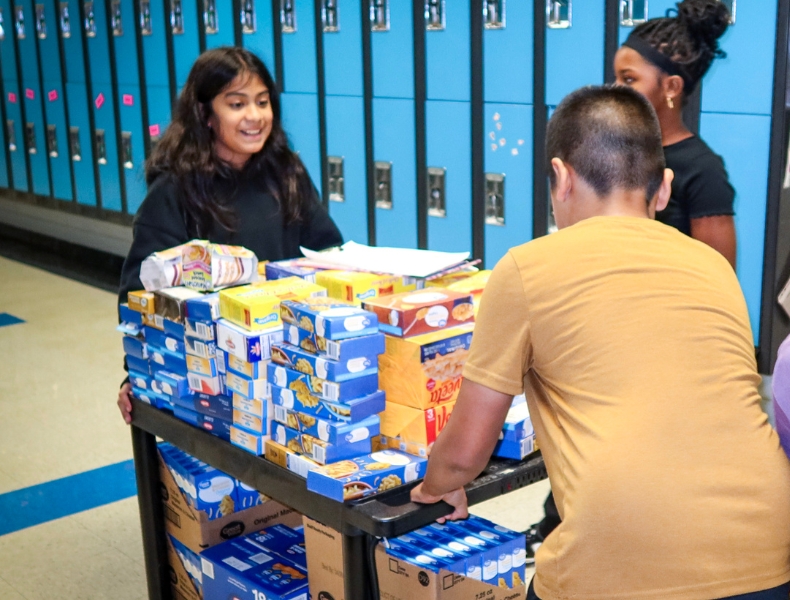
Last year, staff partnered with a local church to better understand the specific food needs in their community, learning how preferences shift based on the time of year and local circumstances. That attention to who they were serving grounded the work in real understanding, helping students feel informed, connected, and invested in their local community. In just one week, students collected 1,668 cans.
This year, they went even further by integrating the End Hunger global challenge into the food drive, ensuring students understood why hunger exists and how it affects people both locally and around the world.
Before a single donation was collected, students gathered on classroom rugs to listen. The school’s global committee organized read-alouds using the book Maddie’s Fridge, helping students explore the connection between poverty and hunger through a story they could relate to. Students talked about access to healthy food, fairness, and what it means to understand someone else’s experience.
Student leaders visited classrooms, not just to collect food but to explain the purpose behind the drive. By the time cans started filling boxes, students weren’t donating out of habit. They were donating with empathy.
The impact was clear: 3,014 food items were collected, nearly double the previous year’s total. And the work isn’t stopping there. Next, older students hope to partner with a local business to create posters that encourage year-round giving, extending learning and action beyond a single week.
Central Elementary: Bringing Empathy to Life Through Service Learning
At Central Elementary (Elizabeth City-Pasquotank Public Schools, N.C.), the fall festival was more than just an event. It was an opportunity to build connection.
The evening began in classrooms, where students created paper “footprints,” each one representing their own experiences and perspectives. Those footprints soon filled a hallway mural—a visual reminder that while everyone walks a different path, empathy connects us.
As families arrived, they added their own footprints to the mural. Conversations unfolded naturally. Children pointed to their artwork. Parents paused to read what others had shared. The message was simple, but deeply felt: Understanding others starts with paying attention to them.
The festival also served as the kickoff for Central’s fall food drive in partnership with the Food Bank of the Albemarle. Families dropped off donations as students played games, made crafts, and exchanged decorated “kindness sticks” with friends.
One moment stood out. A staff member overheard a child asking her father, as he set down a food donation, “Doesn’t that make you feel good to help, Dad?” His answer—“Yes, it does”—captured the essence of purposeful action born from authentic connection.
At both schools, action wasn’t the starting point; it was the outcome of a thoughtful process. Students paid attention. They felt connected. And then they took meaningful action.
Growing Students’ Skills with Food Drives in Schools
What sets these schools apart isn’t the number of cans collected, though that impact is real. It’s the way students were invited into the why behind the work.
By paying attention first, students learned to ask questions. By feeling connected, they built empathy and understanding. When it came time to take action, they did so with purpose.
Just as importantly, this approach helps students develop skills that support career readiness—like perspective-taking, communication, and problem-solving—that prepare them to navigate complex challenges beyond the classroom.
For educators and school leaders, these stories are a reminder that when service learning is intentional, it becomes more than an activity. It becomes a launchpad for career-ready graduates—students who see themselves as capable, compassionate members of their communities, now and in the future.
Looking to bring action-driven learning to your school? Explore how Global Leaders helps students turn understanding into meaningful action.