Across the country, public schools are facing an urgent challenge: student enrollment decline.
Since 2020, more than 1.5 million students have left U.S. public schools, and districts have struggled to recover. This shift is playing out at scale nationwide. But amid this trend, a growing number of schools are not just bouncing back—they’re thriving.
In this article:
- What families are really looking for in schools
- What’s driving enrollment rebound in schools today
- Enrollment data from schools growing amid nationwide decline
- The framework helping schools stand out
- The four pillars driving stronger enrollment, culture, and outcomes
- What the data shows about the link between strategy and enrollment growth
- Why alignment—not more initiatives—drives sustainable growth
- A clear path forward for schools ready to grow
What families are really looking for in schools
Enrollment decline is often a signal that schools are no longer aligned with what families value most. Across our partner districts, we see a consistent pattern: enrollment follows relevance.
Families choose schools that offer learning experiences connected to the real world, future careers, and a deeper sense of purpose. Schools that embrace globally relevant learning position themselves to earn—and keep—family trust. As a result, enrollment stabilizes, and often even grows.
What’s driving enrollment rebound in schools today
Some schools are seeing their enrollment numbers rebound because they align more closely with what families now value in school choice: career readiness, real-world learning, intentional connection with the community, and student belonging. These factors increasingly influence whether families stay, enroll, or transfer.
Why some schools are becoming the top choice for families
Before the pandemic, academic performance was a leading consideration for parents choosing a school. Today, the picture is broader.
Families are prioritizing schools that offer:
- Academics connected to real-world learning and global challenges
- Learning experiences that feel purposeful and future-focused
- Strong ties between the school, families, and the broader community
- Clear pathways to career exploration and skill development
- A culture where students feel seen, valued, and motivated
In short: Families want schools that focus on career readiness and global competencies, and that prepare their children for life beyond graduation, not just testing.
Schools growing even as enrollment declines nationwide
The results from our decades of work with schools tell a clear story: schools that integrate global learning into daily instruction and culture are outperforming matched peer schools in enrollment growth. The data highlights measurable gains and illustrates how some schools are reversing student enrollment declines despite broader national losses.
| School | 2025 Enrollment Gain vs. 2019 | Matched Comparison School | Comparative Advantage |
| Franklinton Elementary (Franklin County Schools, NC) | +41 students | -92 students | +30.7% |
| Fred L. Wilson Elementary (Kannapolis City Schools, NC) | +34 students | -59 students | +19.6% |
| West Oxford Elementary (Granville County Schools, NC) | +20 students | -48 students | +17.7% |
Each of the schools in the table above has implemented Global Leaders—a structured, future-focused global education framework that connects real-world learning, career readiness, and global competencies to everyday classroom experiences—for several years. But even schools newer to the framework, like Heritage Middle (Burke County Public Schools, NC) and Jackson Park Elementary (Kannapolis City Schools, NC) are seeing early signs of enrollment resilience with just two years of implementation. For district leaders, this signals something important: enrollment growth reflects how clearly a school differentiates itself and delivers on what families value.
| School | 2025 Enrollment Gain vs. 2023 | Matched Comparison School | Comparative Advantage |
| Heritage Middle (Burke County Schools) | +23 | -24 | +10.1% |
| Jackson Park Elementary (Kannapolis City Schools) | +58 | +9 | +10.5% |
Parents have started hearing great things about our school, and enrollment has increased. People from out of district have enrolled their students as they learn more about our programming.
—Bethany Bonnemere, Principal, West Oxford Elementary
See the full white paper behind these numbers and discover how schools are reversing enrollment decline.
A different approach: A framework built for today’s schools
As schools rethink how to stay relevant and competitive, many are turning to whole-school models that integrate global learning in a way that’s consistent, scalable, and sustainable Global Leaders is a comprehensive whole-school framework that transforms education through four interconnected pillars, helping schools meet evolving expectations and stand out in a competitive educational landscape.
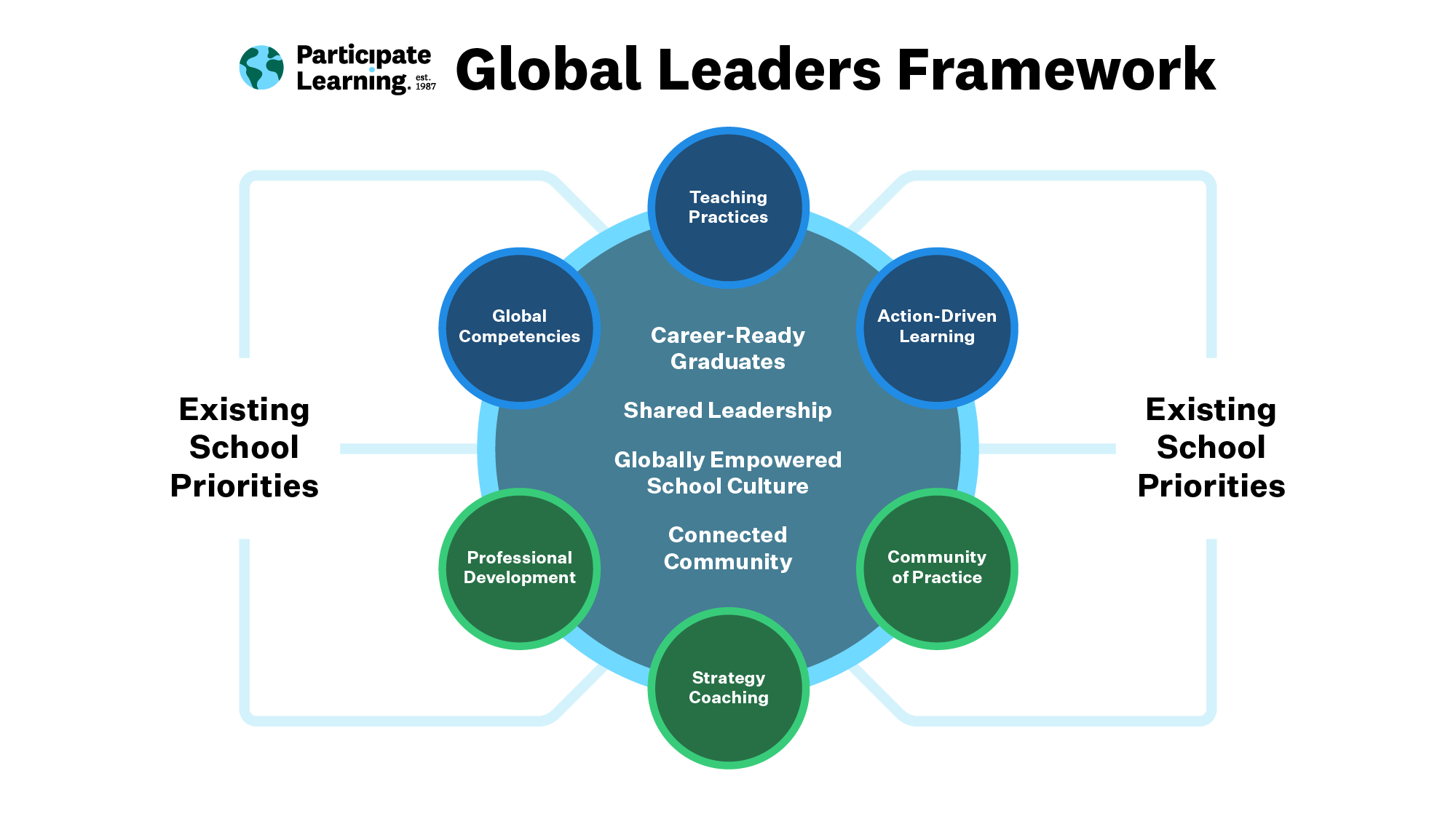
The framework rests on four key pillars:
- Career-Ready Graduates. For school and district leaders, this translates to students who can demonstrate real-world skills, an increasingly important factor in family decision-making.
- Shared Leadership. This kind of shared ownership strengthens school culture and increases family trust, both of which directly influence enrollment and retention.
- Globally Empowered School Culture. A clearly defined and consistently reinforced school identity helps schools stand out in competitive enrollment environments.
- Connected Community. Strong community engagement builds advocacy, which is one of the most powerful drivers of enrollment growth.
Each pillar is grounded in action-driven learning and helps students build essential human intelligence skills such as critical thinking, curiosity, communication, and problem-solving. In Global Leaders schools, these human intelligence skills are known as global competencies—durable skills that empower students to thrive in their future careers and make a positive impact on the world around them. These skills are critical in the current and future workforce.
We are teaching kids the skills they need to be effective in the future. Participate Learning made this an incredible experience for our students and staff.
—Sharon Meads, Principal, Chowan Middle School
See how Global Leaders provides a clear path for schools to stand out in a competitive landscape in our latest white paper.
The four pillars behind stronger student enrollment, culture, and outcomes
The four pillars of Global Leaders work together to create measurable school transformation. Each pillar addresses a different but connected driver of enrollment, from student experience to school culture to community engagement.
1. Career-ready graduates
Students engage in real-world projects that build communication skills, leadership, and career exploration into the school day.
At Heritage Middle School, a student-led initiative to eliminate plastic waste from the breakfast program became a schoolwide project that impacted cafeteria policy and reduced plastic use by hundreds of single-use bags per day.
Students used skills in communication, environmental science, and community organizing, laying the groundwork for future careers in public policy, sustainability, and advocacy.
2. Shared leadership
Students, teachers, and staff all contribute to a school’s direction and culture. At Jackson Park Elementary, leadership is distributed through structured teams that empower everyone to contribute to schoolwide initiatives.
Shared leadership connects our entire staff and empowers students to find ways to make a positive change.
—Caroline Fongemy, Global Lead
When students feel their voices matter, families feel the school is invested in their children—and that builds trust.
3. Globally empowered school culture
Through daily activities and schoolwide celebrations, students and staff recognize global thinking, leadership, and personal growth.
At Fred L. Wilson Elementary, staff use shared language around global competencies like empathy, critical thinking, and self-awareness to shape classroom norms and behavior expectations.
This kind of consistent, unified school identity strengthens student motivation and parent satisfaction.
4. Connected community
Schools become hubs for community action and collaboration. From STEM nights to cultural showcases and global diplomacy experiences, families and community members are invited into the learning journey.
Students also partner with local organizations on service-learning projects that connect academic standards with real-world impact and demonstrate the school’s value both inside and outside the building.
Explore Global Leaders in action and learn how each pillar transforms school culture in From the Inside Out: How the Global Leaders Framework Drives Enrollment Resilience and School Transformation.
What the data shows: A clear link between strategy and enrollment growth
Global Leaders includes five levels of school designation—Establishing, Journey, Accomplished, Showcase, and School of Excellence—which reflect a school’s progress in implementing the framework with fidelity. Each level signals increasing alignment with the framework’s four pillars and deeper, schoolwide impact on student learning and school culture.
Data from North Carolina schools shows a clear connection between designation level and enrollment resilience. This reinforces a key takeaway for leaders: enrollment growth is not driven by isolated programs but by consistent, schoolwide alignment around a clear, differentiated school identity and direction.
- Schools with Showcase or Accomplished designations experienced the most significant enrollment gains.
- Even schools at the Journey level showed positive trends when compared to matched peer schools.
- Schools that paired Global Leaders with Dual Language Programs saw amplified enrollment advantages, strengthening both academic distinctiveness and family engagement.
Why does this work?
Because Global Leaders addresses the factors now driving school choice decisions:
- It helps students build career-relevant skills.
- It brings clarity and purpose to the school culture.
- It fosters pride and word-of-mouth advocacy from families who feel connected to their school.
This shows parents that our public school offers something they cannot get anywhere else.
—Kimberly Robertson, Principal, J.C. Sawyer Elementary
Why alignment, not more initiatives, is the real driver of growth
One of the biggest barriers to school transformation is initiative fatigue. Progress often comes not from adding more programs, but aligning what’s already in place. One of the reasons Global Leaders is so effective is that it supports existing school goals instead of adding disconnected initiatives. Schools can strengthen culture and address enrollment challenges without creating staff burden.
Rather than adding more to educators’ plates, the framework:
- Strengthens current school improvement plans
- Enhances existing initiatives and programs
- Uses clear, aligned indicators of success to track progress without requiring new systems or extra reporting
Schools receive ongoing support from a dedicated strategy coach, access to a robust community of practice, and tailored professional development to support long-term success.
A clear path forward for schools ready to grow
Enrollment growth for today’s schools is about differentiation. Schools that clearly define and communicate a future-focused identity are better positioned to attract and retain families. Schools that clearly communicate a distinctive value proposition are better positioned to attract families and sustain long-term enrollment strength.
Global Leaders gives schools a clear, future-focused identity rooted in real-world impact, student voice, and connected learning. And it’s proving to be a sustainable strategy for:
- Boosting enrollment
- Increasing community trust
- Preparing students for success in any career path
The enrollment resilience study provides detailed evidence of how this framework transforms school outcomes and community engagement.
Go deeper: Explore the full enrollment resilience study
Explore the full enrollment resilience study to see how schools are implementing global learning strategies and achieving measurable results.